Why Your Automatic Pool Cleaner Stopped Working
Your pool cleaner is supposed to do the boring work for you. When it stops, it usually stops for a reason.
If your robotic cleaner is parked in one spot, spinning in circles, or sitting dead on the bottom, and your pressure-side cleaner has gone still or is barely crawling, the pool is telling you something. Most of the time it's not the cleaner itself. It's something upstream that's starving it of power, suction, or clean tracks to move on.
Start With Which Type of Cleaner You Have
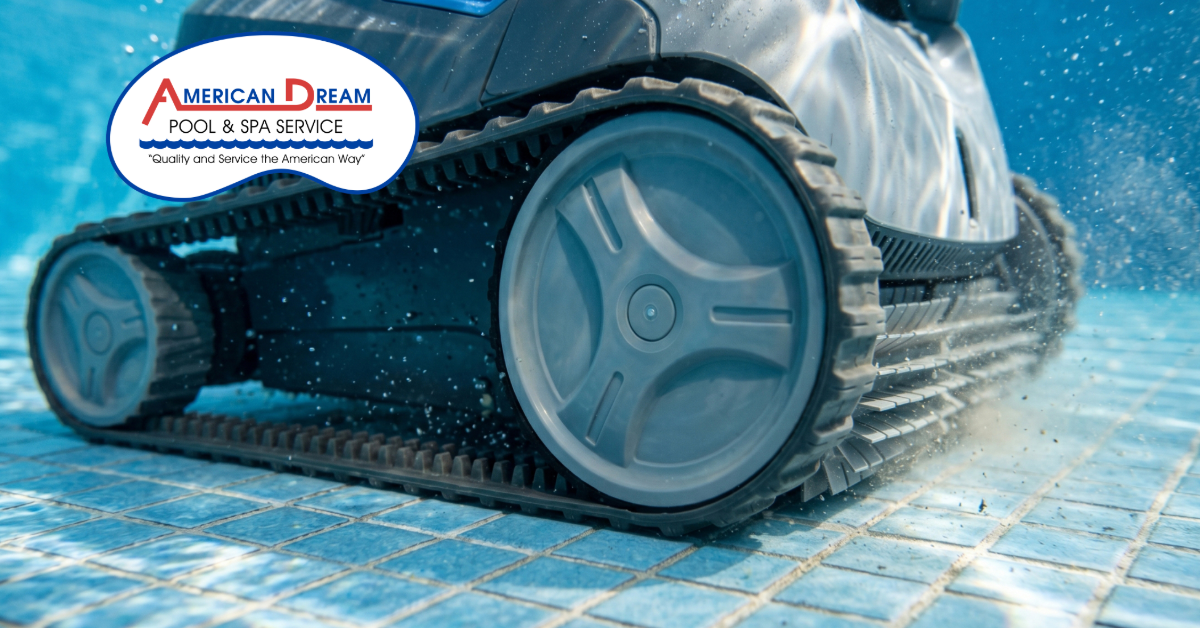
The fix depends on the kind of cleaner you're running.
Robotic cleaners plug into an outlet and run independently of your pump and filter system. If one stops working, the problem is almost always electrical or mechanical, inside the unit or its power supply.
Pressure-side cleaners run off your pool's return line pressure, often with a booster pump. If one slows down or stalls, the problem is usually flow related, somewhere between your pump and the cleaner itself.
Suction-side cleaners run off your skimmer suction. If one stops moving, look at anything that could be reducing suction at the skimmer.
Knowing which category you're in cuts the troubleshooting list in half before you even start.
Robotic Cleaner Sitting Still or Spinning in Place
A robotic cleaner that won't move usually points to one of a few things.
The power supply unit isn't getting a full charge to the motor. Check the connection where the cord meets the caddy or wall unit, and confirm the outlet itself is working.
The impeller or drive belt is jammed. Debris, hair, or a small toy can lodge inside and stop the wheels or tracks from turning even though the motor is running.
The filter bag or cartridge inside the unit is packed solid. A robotic cleaner working against a clogged internal filter will bog down and eventually stall, especially after a heavy debris season.
If the unit powers on, makes noise, but doesn't move, it's almost always mechanical. If it doesn't power on at all, start with the power supply and the outlet before assuming the unit itself has failed.
Pressure-Side Cleaner Slowing Down or Stalling
Pressure-side cleaners depend on flow, so a slowdown usually traces back to something restricting it.
A clogged pump basket or skimmer basket reduces the flow available to push the cleaner along, even if the pump sounds normal.
A worn or torn cleaner bag lets debris recirculate instead of collecting, which can also make the unit seem sluggish even when flow is fine.
A weak or failing booster pump, if your system uses one, is one of the more common culprits on pressure-side units that used to move well and now barely crawl.
Worn wheels or a cracked hose can also rob the unit of the push it needs to climb walls or cover the whole floor.
If the cleaner moves fine in the shallow end but stalls in the deep end or on walls, that's often a flow or wheel wear issue rather than a full system problem.
Suction-Side Cleaner Stopped Moving
These are the simplest units, which also makes them the easiest to diagnose.
Check the skimmer basket first. A full basket is the single most common reason a suction cleaner slows down or stops.
Look for air in the line. A hose connection that isn't fully seated will pull air instead of water, and the cleaner will lose the suction it needs to crawl.
Inspect the hose for kinks or cracks. Northern California sun is hard on cleaner hoses over a season, and a cracked section will bleed off suction before it ever reaches the unit.
When It's Not the Cleaner at All
Sometimes the cleaner is fine and the problem is upstream. If your filter pressure is running high, your pump basket is full, or your pump has lost prime, every type of cleaner will underperform no matter how new it is. Worth checking your pump and filter before assuming the cleaner needs to be replaced.
Why Debris Load Matters More Here Than You'd Think
Homes in Loomis, Penryn, and Sheridan tend to sit on larger lots with more oak and pine cover, which means more debris finds its way into skimmers, cleaner bags, and pump baskets over the course of a week. That debris load is one of the more common reasons a cleaner that worked fine last month suddenly seems weak. In Rocklin, Roseville, Lincoln, and Granite Bay, hard municipal water can leave scale on wheel bearings, tracks, and internal impellers over a season, which shows up as a cleaner that runs slower and quieter than it used to rather than one that stops outright. Either way, the fix usually starts with cleaning, not replacing.
When to Call for a Diagnostic
If you've checked baskets, hoses, and connections and the cleaner still isn't moving right, it's worth having someone look at the pump and filter system behind it rather than guessing at parts. A cleaner that won't move is sometimes the first visible sign of a pump or filter issue that hasn't shown up anywhere else yet.
If you're in Lincoln, Rocklin, Roseville, Granite Bay, Loomis, Penryn, or Sheridan and your pool or spa cleaner has stopped pulling its weight, reach out and we'll take a look. We offer pool repairs, pool service, spa repairs, and spa service across Placer County, including Lincoln, Rocklin, Roseville, Granite Bay, Loomis, Penryn, and Sheridan.